The week in brief
- GitHub releases agentic workflows for Actions. The engineering decision is which repository effects a workflow may produce when its inputs include prose from someone outside the team.
- Workflow lockfiles can pin transitive Actions dependencies. The lockfile adds a reviewable boundary around a dependency change.
- Push protection previews detection beyond known secret formats. This could help protect a service whose credential format resembles ordinary application data.
Act now, Evaluate and Watch are ACW’s editorial assessment, not a rating by an independent agency.
GitHub releases agentic workflows for Actions
ACW assessment: Evaluate. A relevant new option has appeared and is worth checking.
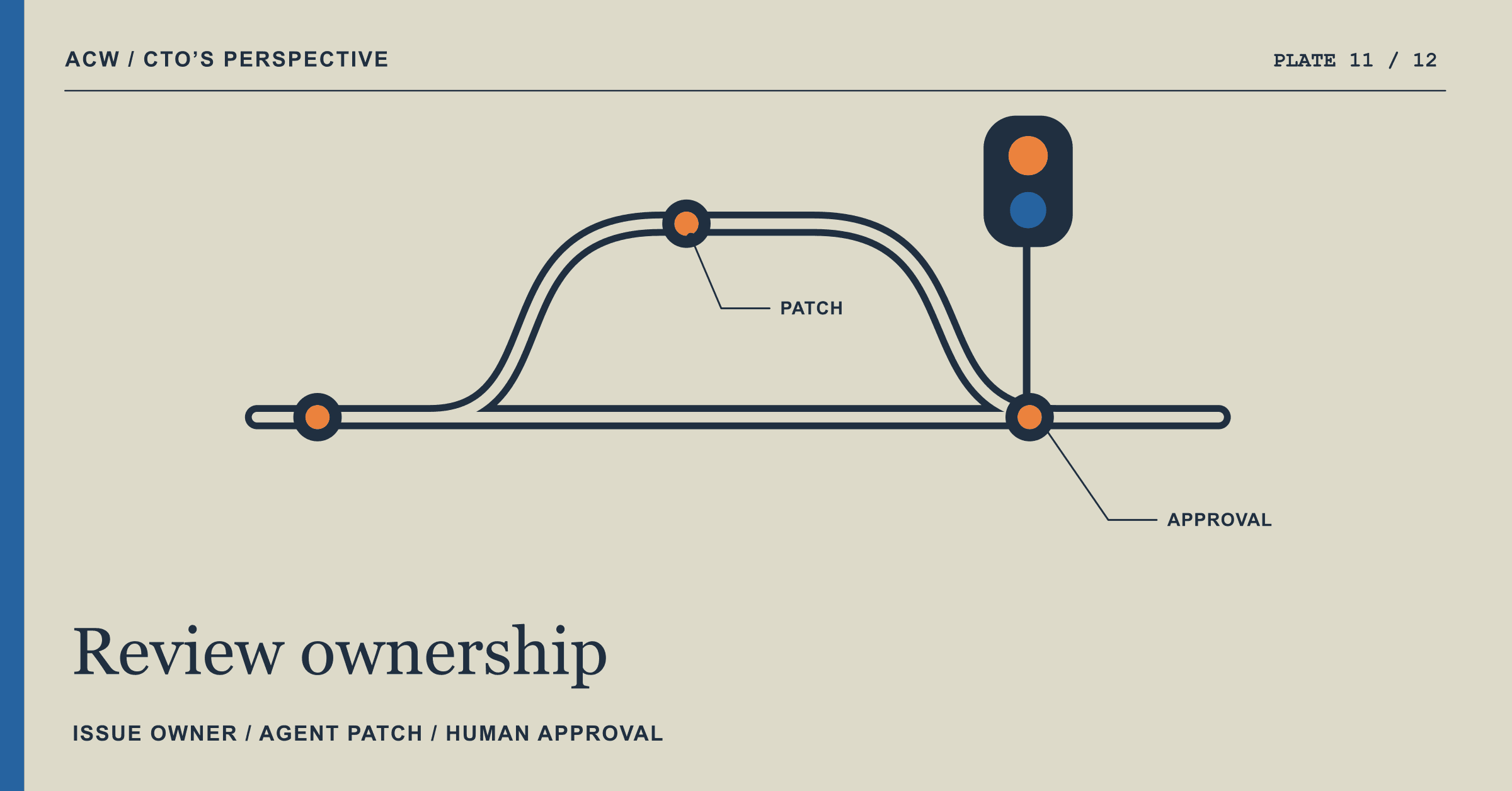
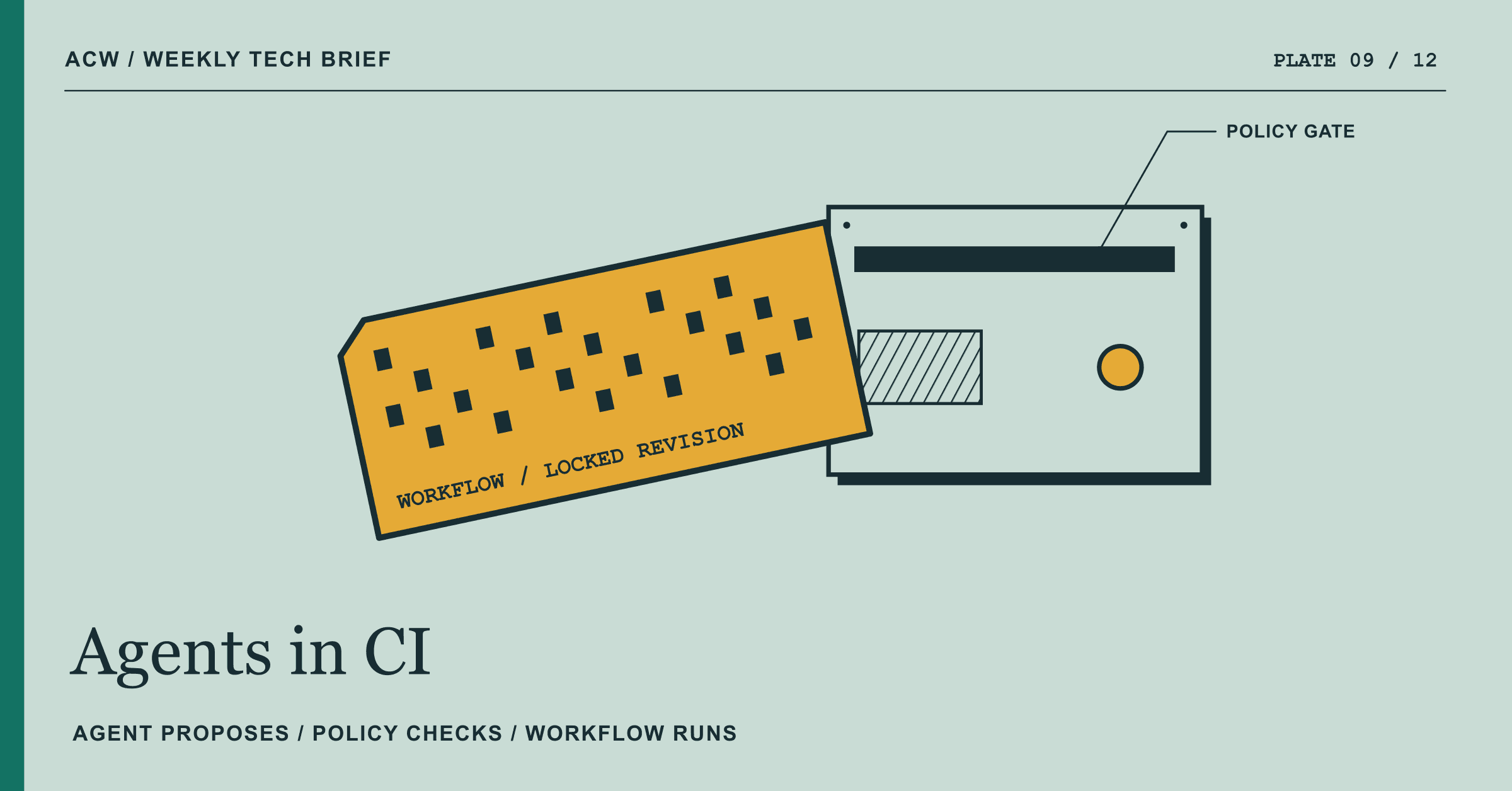
What happened. GitHub announced general availability of Agentic Workflows. The project compiles Markdown workflow definitions into Actions YAML and supports tasks such as issue triage and CI failure analysis. [1]
Why it matters (ACW analysis). The engineering decision is which repository effects a workflow may produce when its inputs include prose from someone outside the team. A failure-analysis workflow that summarizes logs has a different scope from one that opens a pull request or changes a label used by release tooling. Evaluate the identity that performs the downstream operation, the systems that trust it and the way reviewers can reconstruct its inputs.
Who is affected: Platform engineers, repository administrators and release owners.
What to do next. Start with a disposable repository and one read-oriented triage question. Give the workflow an issue containing an irrelevant instruction and a build log with a plausible but incorrect explanation. Inspect the generated workflow, the runtime permissions and the final output. Decide which proposed actions need human approval before they affect a protected branch. Keep a record of the workflow revision and the permitted effects. Expand to a consequential operation only after a maintainer demonstrates how to revoke permission while preserving the investigation record for work already in progress.
Source: GitHub Agentic Workflows generally available (opens in a new tab)Event date: · Verified:
Workflow lockfiles can pin transitive Actions dependencies
ACW assessment: Evaluate. A relevant new option has appeared and is worth checking.
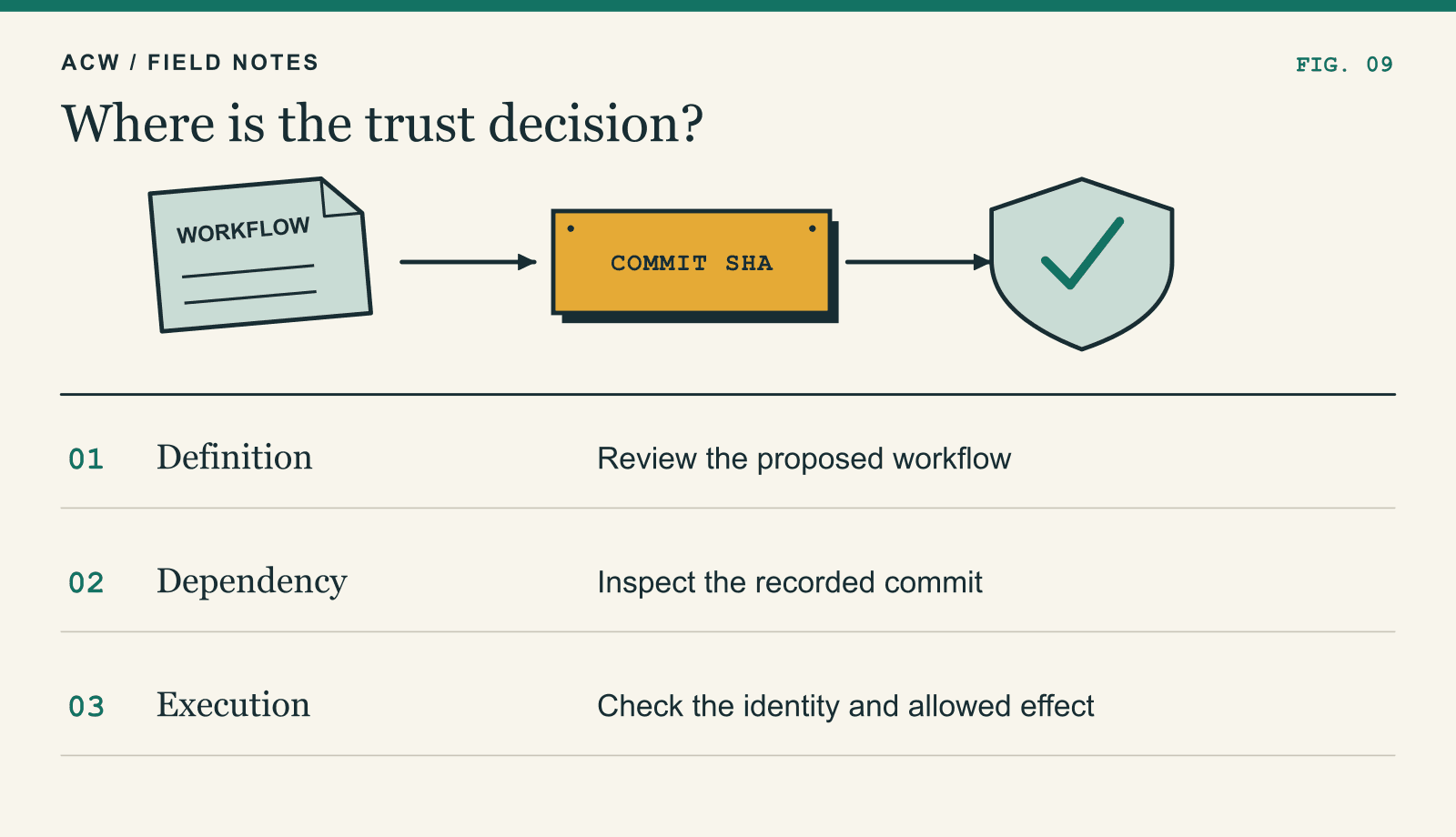
What happened. GitHub moved Actions workflow lockfiles to general availability on the plans listed in its announcement. Teams can keep readable dependency references while executing the specific commits recorded in a lockfile, including transitive actions. [2]
Why it matters (ACW analysis). The lockfile adds a reviewable boundary around a dependency change. A team gains most when reviewers can see why a new commit is acceptable and which workflows will run it.
Who is affected: Build engineering and repository owners.
What to do next. Choose one workflow that calls a reusable action. Generate its lockfile and inspect the transitive entries. Exercise a dependency update in a pull request and identify the person responsible for reviewing the change. Verify how an unlocked dependency behaves before applying an organization-wide policy.
Source: GitHub Actions workflow lockfiles are generally available (opens in a new tab)Event date: · Verified:
Push protection previews detection beyond known secret formats
ACW assessment: Evaluate. A relevant new option has appeared and is worth checking.
What happened. GitHub announced public-preview push protection for AI-detected secrets in eligible repositories with the prerequisite settings enabled. The classifier uses surrounding code to assess potential credentials without a predefined format. [3]
Why it matters (ACW analysis). This could help protect a service whose credential format resembles ordinary application data. Legitimate configuration values may also require a developer to explain or investigate a block.
Who is affected: Security engineering and developer experience leads.
What to do next. Pilot in one repository with an assigned responder. Prepare a safe test fixture and a legitimate lookalike value. Observe the developer experience for a block, including the route for requesting an exception. Track whether the person approving a bypass can establish the business reason without copying a suspected secret into another system.
Source: Push protection beyond predefined secret patterns (opens in a new tab)Event date: · Verified:
AI application code scanning enters public preview
ACW assessment: Evaluate. A relevant new option has appeared and is worth checking.
What happened. GitHub announced preview scanning for vulnerabilities in AI applications and agents. Its stated coverage includes indirect prompt injection, sensitive information disclosure and excessive agency, with scans running on pull requests. [4]
Why it matters (ACW analysis). A finding can direct attention to a risky connection between untrusted text and a tool. An engineering team still needs to verify which actions its deployed identity can perform and whether users can cross permission boundaries at runtime.
Who is affected: Application security and teams building tool-using agents.
What to do next. Trace one route from an external document to a tool call. Identify the policy check immediately before the effect, then exercise a denied operation in a controlled environment. Give any alert to the person who owns that boundary and record what the team verified outside the scanner.
Source: Code scanning for AI applications in public preview (opens in a new tab)Event date: · Verified:
Sources and further reading
- GitHub Agentic Workflows generally available (opens in a new tab). GitHub · 28 Oct 2026 · Accessed 4 Nov 2026
- GitHub Actions workflow lockfiles are generally available (opens in a new tab). GitHub · 28 Oct 2026 · Accessed 4 Nov 2026
- Push protection beyond predefined secret patterns (opens in a new tab). GitHub · 28 Oct 2026 · Accessed 4 Nov 2026
- Code scanning for AI applications in public preview (opens in a new tab). GitHub · 28 Oct 2026 · Accessed 4 Nov 2026
About the author. Oleksandr Veklych, Co-founder & CTO, ACW Soft Solutions. Oleksandr Veklych is the CTO and co-founder of ACW Soft Solutions, where he leads technical strategy and delivery for custom software: SaaS platforms, marketplaces, internal business systems, mobile apps and AI-based solutions. His focus is turning growing complexity into clear architecture, reliable delivery and scalable technical decisions, so teams can move faster without rebuilding everything. He holds a bachelor’s degree in cybersecurity from Taras Shevchenko National University of Kyiv. View profile