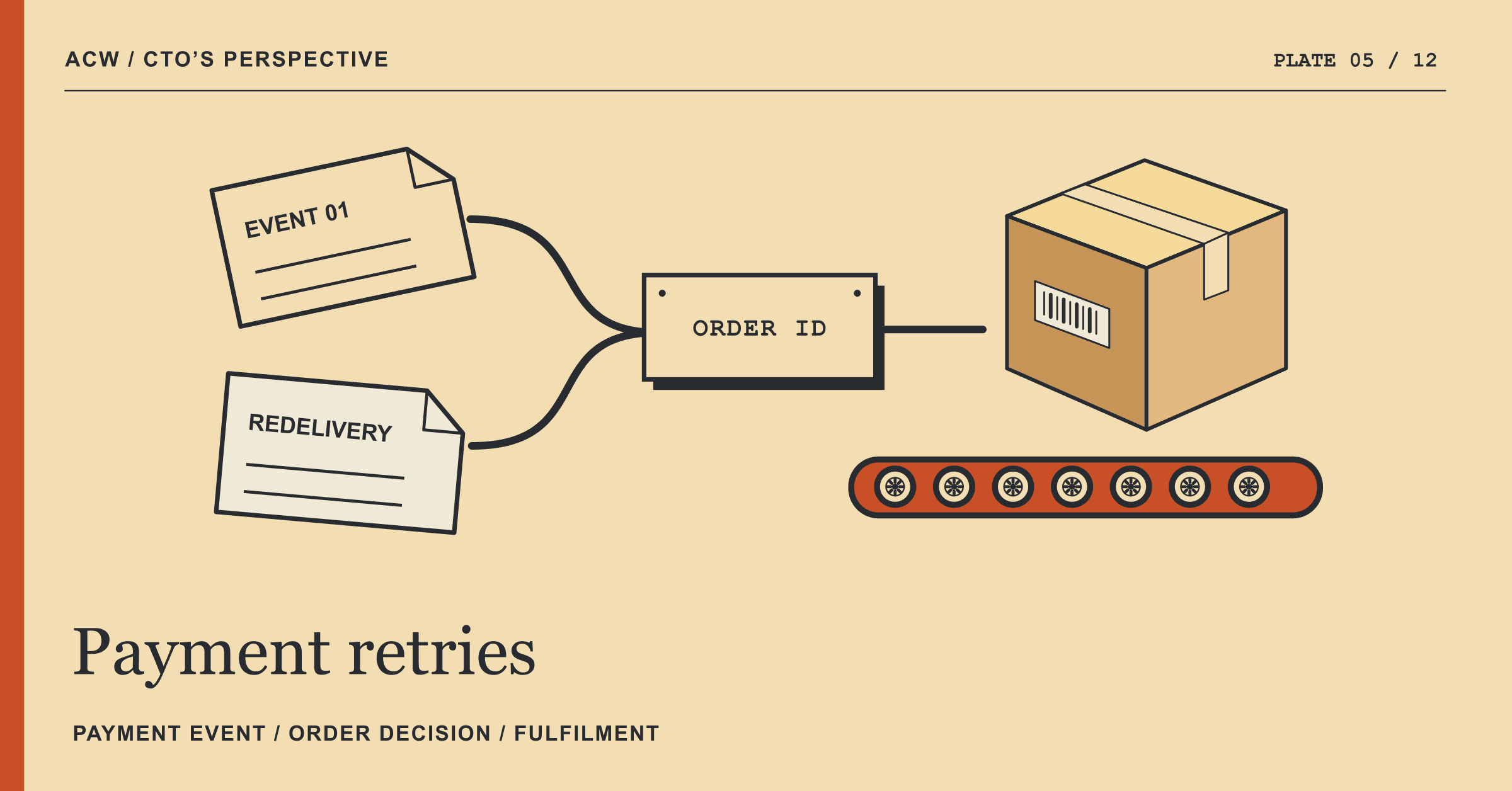
Record one durable fulfilment decision per intended order effect, retain the provider event identifier and reconcile uncertain warehouse responses before resubmitting. Test duplicate, delayed and concurrent deliveries against the downstream parcel and notification records. This approach fits a store that owns the order state and can identify an outbound shipment after a timeout.
What are we evaluating?
Review basis. Documentation review. Conclusions drawn from official documentation and published material, without a test of our own.
Methodology. Reviewed Stripe webhook documentation and used ACW’s e-commerce publication as the topic seed. Traced a hypothetical order from payment to warehouse acceptance. No hands-on or production runs were performed.
What does the business promise after payment?
Give each paid order one fulfilment decision that survives a retry. A customer can tolerate a delayed receipt more easily than two parcels or a paid order that vanishes from the warehouse queue. Define the invariant in terms the warehouse can observe. For a one-parcel order it might be one accepted shipment request for the paid order revision.
A hypothetical fragrance store sells two identical bottles as one order. The correct result is one shipment containing two units. A rule that blocks any repeated product identifier would prevent the legitimate second bottle. A rule that trusts every incoming payment notification might ship four. Decide what the fulfilment unit is before choosing the identifier that protects it.
ACW's e-commerce publication describes a storefront with a dynamic catalogue and payment integration. This article uses a separate hypothetical warehouse to examine the boundary between a payment event and delivery. The integration discussion is transferable to a custom store even if it uses different inventory software.
Where should duplicate protection live?
Store a durable record of the fulfilment decision under a key that identifies the intended business effect. The provider event identifier is also useful for diagnosing redelivery. Distinct events can describe the same order outcome. If both reach the handler, the order-level constraint should still prevent a second initial shipment.
Place the state change and the intent to fulfil in a single database transaction when the store controls that database. A worker can deliver the recorded intent to the warehouse afterwards. This design addresses a common crash window. If the process marks an order paid and dies before writing the work item, a warehouse that reads only the queue never learns about the order.
A unique constraint can arbitrate between two handlers racing on the same decision. An in-memory check followed by a later insert leaves a gap in which both handlers can conclude they are first. Decide what the losing handler returns and logs. A harmless duplicate should be distinguishable from an earlier attempt whose warehouse outcome is still unknown.
What if the warehouse accepts a request and the response is lost?
Treat a timeout as an unknown outcome. The remote system may have accepted a shipment while its reply never reached the worker. Retrying immediately with a new shipment reference makes two shipments possible. Persist the outbound reference before sending, reuse it where the partner supports that behavior and look up the original request before creating another.
Ask the warehouse partner what its uniqueness guarantee covers, how long it remembers submitted references and what happens to a request with the same reference but different contents. Render these answers as three operational cases. A confirmed shipment can advance. A confirmed rejection may be corrected. An unresolved request waits for a person with access to both systems.
In the two-bottle example, imagine the carrier label already exists but the order page still says processing. The fastest safe action may be to attach the existing label to the order. Printing another label because the page looks unfinished creates a new piece of warehouse work. The status shown to the shopper must reflect what the operations team actually knows.
How do you test late events and partial refunds?
Write a short history of a transaction before testing it. For instance, payment is confirmed, stock is reserved, the customer requests a cancellation and an older notification arrives after the refund starts. Decide what transitions are still allowed. An older event should not silently reopen a closed order because its arrival time happens to be later.
Replay events against a disposable order in several sequences. Use two workers for the duplicate case and interrupt the process after durable writes for the crash case. Verify downstream effects as well as database rows. One order row can still coexist with two labels, two pickup requests or two customer messages. Keep each effect's reference available for inspection.
Test partial fulfilment separately if it exists. A split shipment, replacement or second delivery after damage is legitimate business work with its own authorization. A deduplication rule that permanently blocks a second parcel for every order can create customer harm of its own. Give operations a documented, auditable way to approve an additional shipment under a new business reason.
Which discrepancies need a human decision?
Reconcile payments, orders and warehouse acknowledgments using stable references. The exception list should say what is missing. Paid with no recorded fulfilment intent is a different case from submitted with no warehouse confirmation. Give the person on duty a next step, the safe lookup and a point beyond which retries must stop.
Track the age of unresolved orders alongside the count of duplicate attempts. A spike in redelivery with every order fulfilled once may be manageable. A single high-value order stuck past its dispatch cutoff may deserve immediate attention. Put these measures next to the warehouse's actual shipping schedule so an engineer can connect a technical alert to the customer's promise.
Release when a replay produces the expected inventory and shipment effects, ambiguous responses enter reconciliation, and an operator can recover without inventing a new identity for the same work. Revisit the design before introducing delayed payment methods, marketplace sellers or cross-warehouse splits. Each changes which business decision deserves its own durable record.
How would a reconciliation drill work on Monday morning?
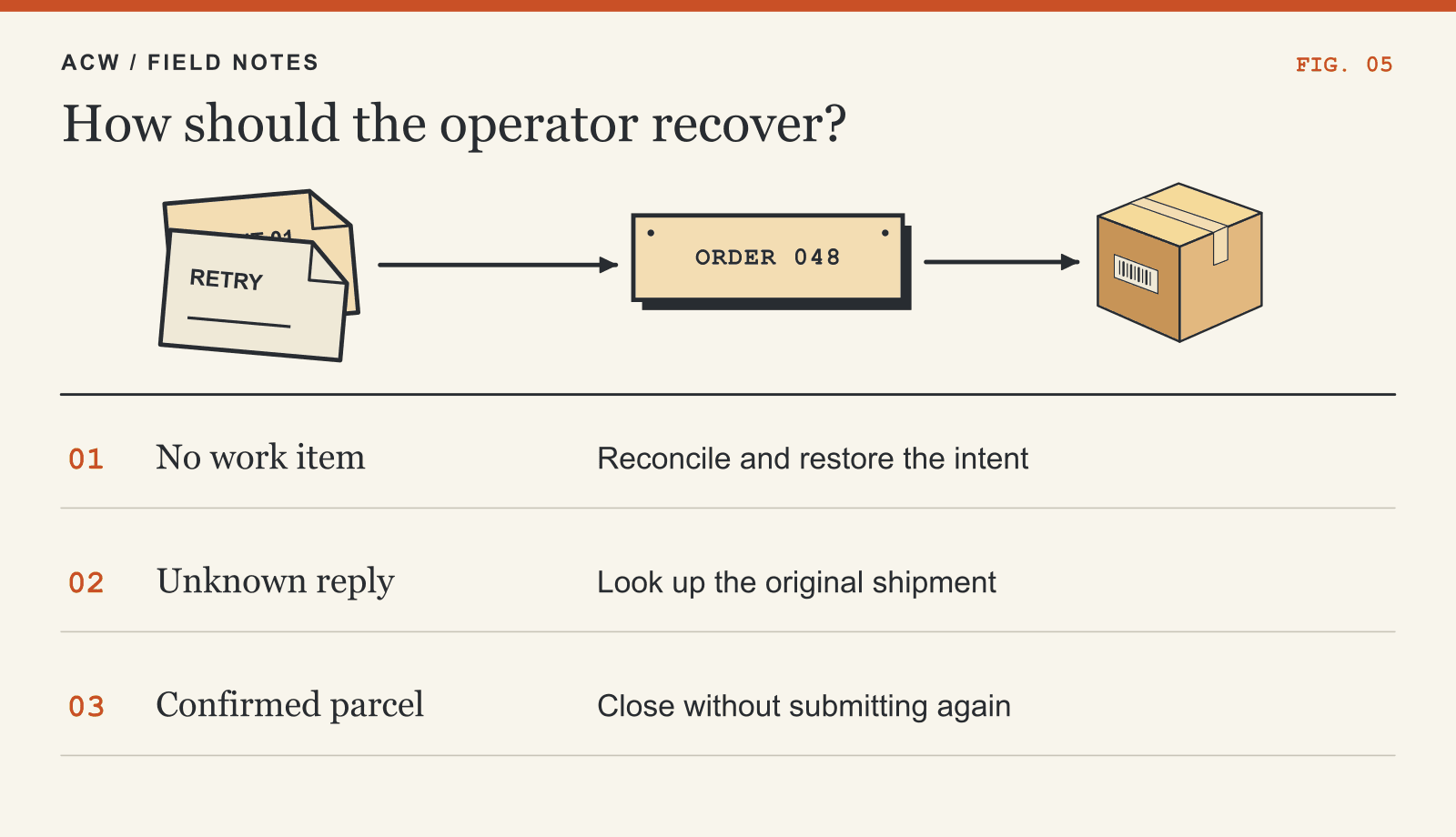
Give the operator three synthetic orders with deliberately different histories. The first is paid with no work item. The second has a work item and a warehouse reference but no reply. The third has two provider deliveries and a single confirmed shipment. Ask the operator to write the next permitted action for each before touching the recovery controls. The exercise reveals whether the status vocabulary carries enough information to act.
For the first order, identify how to recreate the missing work item while preserving the original business key. For the second, query the warehouse using its original reference and hold the order if lookup is unavailable. For the third, confirm that the parcel contents match the purchased quantity and close the discrepancy. Three superficially similar alerts produce three different outcomes. A generic retry button would be inappropriate in at least one of them.
Repeat the drill during a shift handover. The first operator should be able to leave a concise recovery note describing what was queried, what was observed and which step remains open. The next operator should be able to continue without calling the customer for information already held by the store. If two people can resume the same recovery concurrently, apply the same ownership rules used for automatic retries.
Finally, compare the customer-facing wording with the internal state. An unresolved warehouse response should not produce a dispatch confirmation. A successful reconciliation should update the normal order history so that support staff do not need a private spreadsheet to tell the customer what happened. Verify that a delayed confirmation cannot send a second email after an operator has already resolved the order manually.
Keep the three records as release fixtures when changing the queue or payment provider. They capture the behavior of the business at the point where software, staff and a physical shipment meet.
Include financial reconciliation in the same review. A shipment can be correct even when the customer was charged twice, and reversing a duplicate charge may leave inventory untouched. Keep payment, order and shipment identifiers distinct in the case record. Ask the finance operator to demonstrate which of the three ledgers they would inspect first and why the remaining two still need checking before the incident can close.
Check one order that crosses midnight in the warehouse’s local timezone. An operator searching by the payment date alone may overlook a dispatch recorded on the following day.
What are the limitations and trade-offs?
- Warehouse lookup and idempotency guarantees vary by partner.
- Only the merchant can define split-shipment and replacement policies.
Sources and methodology
- Receive Stripe events (opens in a new tab). Stripe · Accessed 4 Nov 2026
- E-commerce experience (opens in a new tab). ACW Soft Solutions · Accessed 4 Nov 2026
About the author. Oleksandr Veklych, Co-founder & CTO, ACW Soft Solutions. Oleksandr Veklych is the CTO and co-founder of ACW Soft Solutions, where he leads technical strategy and delivery for custom software: SaaS platforms, marketplaces, internal business systems, mobile apps and AI-based solutions. His focus is turning growing complexity into clear architecture, reliable delivery and scalable technical decisions, so teams can move faster without rebuilding everything. He holds a bachelor’s degree in cybersecurity from Taras Shevchenko National University of Kyiv. View profile