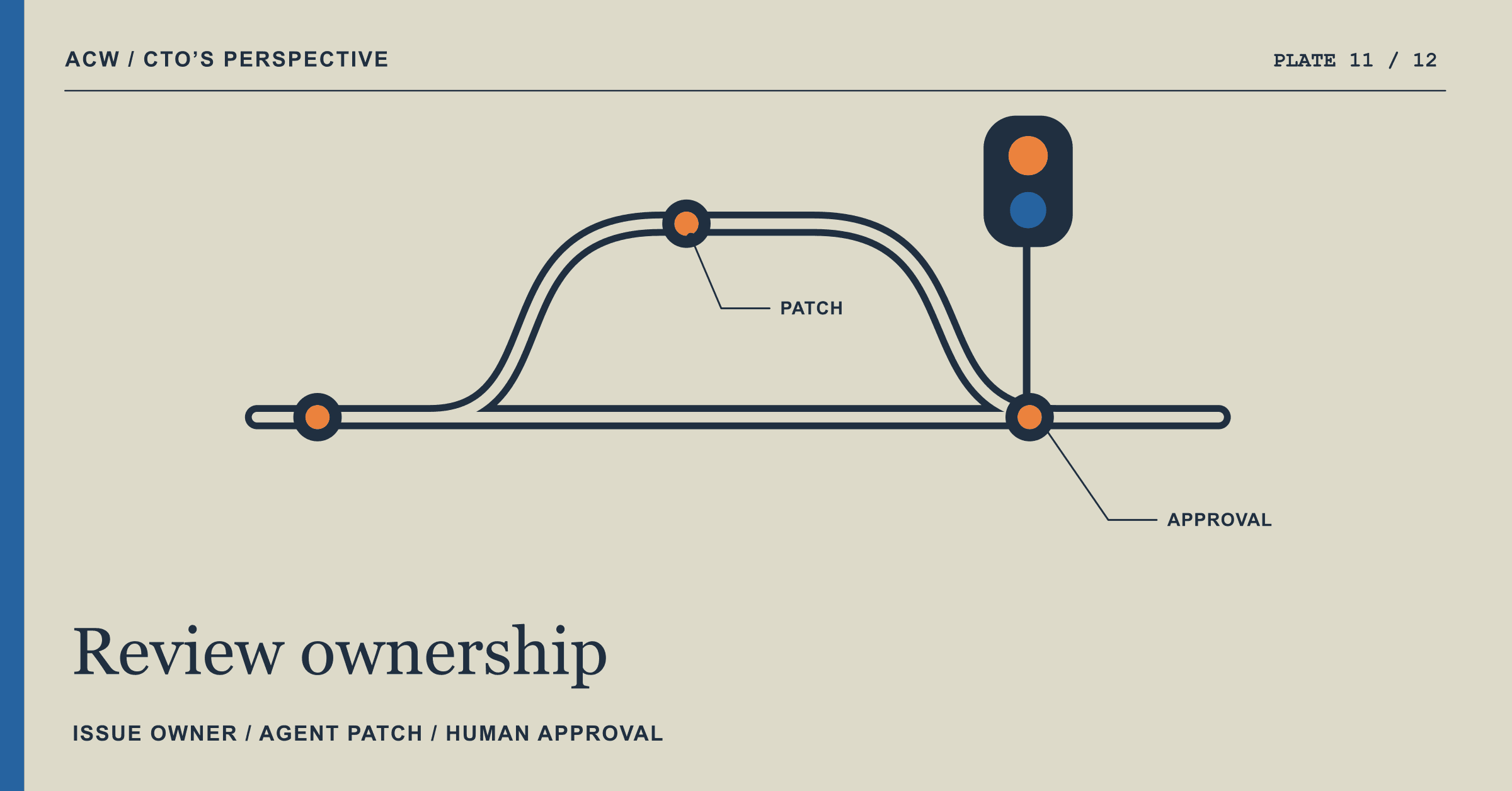
A human with responsibility for the affected behavior should approve an agent-written change. For billing or access, name the product decision owner and the engineer who can trace implementation and recovery. Require an acceptance example written independently of the proposed patch, then verify the customer-visible effect before authorizing release. Record who can reverse it.
What are we evaluating?
Review basis. Documentation review. Conclusions drawn from official documentation and published material, without a test of our own.
Methodology. Reviewed GitHub’s Copilot agent documentation and ACW’s published approach to code review. Used a hypothetical cancellation change to trace ownership from request to release. No hands-on or production runs were performed.
Who owns the change after the agent opens a pull request?
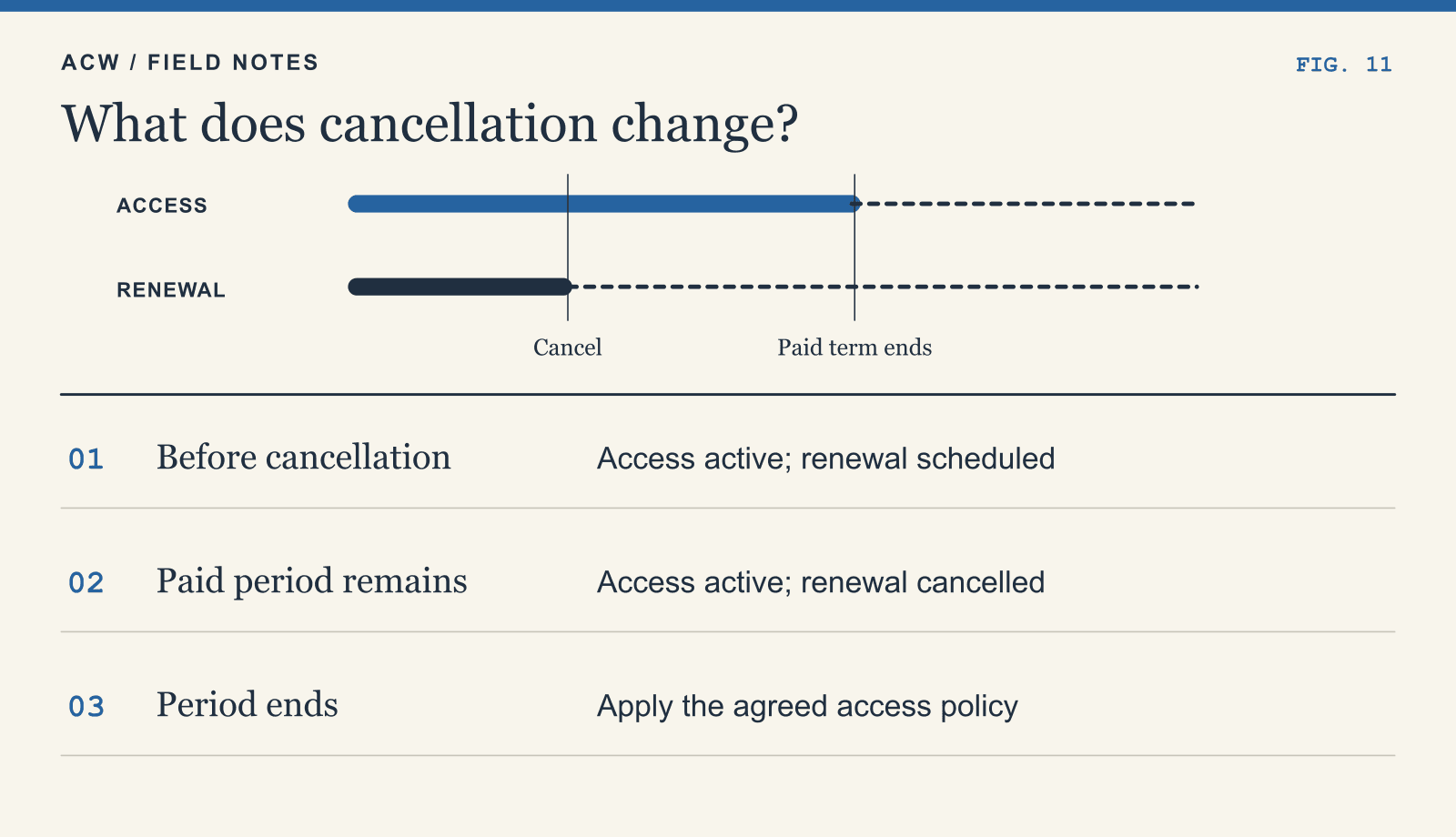
Assign a human owner who can explain the proposed behavior and accept the consequences of releasing it. A coding agent can submit a coherent patch while misunderstanding the one condition that matters to a customer. A pull request improving how a subscription product handles cancellation illustrates the problem. The code might stop renewal immediately and still mishandle access already paid for.
GitHub documents its Copilot agents and their responsible use. ACW's company publication describes a similar expectation for AI-written changes: a reviewer should understand the code before deployment. This review translates those positions into a release decision for a hypothetical subscription service. No repository or agent was tested.
Write the owner in the issue before assigning work. If the intended change touches billing and access, the team needs someone who understands both or a defined review split. A developer can verify that a database update is consistent while a product owner checks the end-of-term promise. Record who can resolve a disagreement between the two before release pressure makes that decision harder.
What should the issue tell the agent?
Describe a customer-visible transition with enough detail to distinguish correct implementations. A request to improve cancellation leaves the model free to choose policy. A request to stop the next renewal while preserving access until a stated period ends gives it a target that can be exercised. Include dates at the relevant boundary and explain how the customer learns the result.
Separate the requested change from nearby work. If the team also wants to refactor invoice emails, assign that to another issue. A larger patch may look economical to generate while taking longer for the reviewer to reason about. A small behavioral change with an explicit boundary makes it easier to determine whether an added dependency or schema change is justified.
Ask the author of the issue to name one apparently plausible outcome that would be wrong. Examples include charging a customer after renewal was cancelled or removing access before the paid period ends. This gives the reviewer a way to challenge a green test report. Include who should receive a support alert if the two systems disagree.
Which tests should come from outside the proposed patch?
Write an independent acceptance example before inspecting the generated tests. A patch and its tests can encode the same wrong assumption about a business rule. A green suite then proves that two pieces of code agree. The independent example should come from a product policy, an existing contract test or a colleague who can justify the expected outcome.
For the cancellation example, choose an account whose next charge occurs at a known boundary. Cancel before that boundary, inspect access on both sides and verify the renewal job's behavior. Add a repeated cancellation request. The customer should see a stable result and the ledger should show only the intended change. Capture the actual chosen timezone when setting up the fixture.
Inspect what each assertion observes. A test that verifies a method was called cannot alone establish that the customer retained access in the downstream product. The acceptance check should read through the same path that enforces the entitlement. Where staging integrations differ, record the untested boundary and give responsibility for the deployment check to someone who can observe it.
How much code should a reviewer read?
Read from the entry point to the business effect, then inspect the routes that can bypass the new logic. For cancellation, trace the browser request, API handler, subscription state transition, renewal scheduler and entitlement check. Map which of those components changed. If a new helper appears harmless but other paths call it, inspect the implications for each caller.
Examine what the patch removes. Deleting a fallback can be the correct fix for a duplicate action, or it can remove the only recovery path for older subscriptions. Look for persisted records created under an earlier schema. Ask what an existing customer sees when the new code encounters a value that the freshly generated test data never includes.
Set a stopping condition for review. If a reviewer cannot explain how to reverse a state change or what happens to a charge already sent for collection, return the change for clarification. Asking the coding agent for another summary may help locate code, but the person accepting the release still needs independent evidence for the consequential behavior.
What should happen when the implementation and policy disagree?
Take the conflict back to the policy owner while the pull request is still open. A common example is a scheduled cancellation followed by a plan upgrade. Should the upgrade revoke the cancellation, create a new subscription or preserve both decisions? That choice has billing and support implications. Letting an implementation detail settle it can turn one customer's edge case into an undocumented product rule.
Record the chosen outcome as an example, along with conditions where it does not apply. A business subscription might follow a negotiated contract while a consumer plan uses standard renewal rules. If the team cannot express the exception without private customer information, build synthetic fixtures that preserve the relevant structure and remove the identifying details.
Once a decision changes, let the agent update the implementation and the tests. Ask a human to inspect the revised behavior against the independent example. Preserve the reasoning behind the exception for the next reviewer. The next agent working on the same subsystem is less likely to remove a rule that has a clear, observable purpose.
What does acceptance look like during rollout?
Authorize deployment when the stated behavior is observed, the reviewer understands the affected paths and an operator can detect and correct a bad outcome. Identify an early cohort where support can investigate a discrepancy without exposing sensitive billing data. Choose measures tied to the change, such as continued access until the correct date or an unexpected renewal attempt.
Design the rollback around state already written. Restoring the previous executable does not necessarily restore a subscription whose renewal date was cleared. Before rollout, identify the state transitions that can be corrected automatically and those that require manual reconciliation. Keep a record that lets someone find the affected accounts without retracing the entire release.
A fast approval is reasonable for a small, reversible change with an independent acceptance test. A change that alters paid access or writes irreversible state deserves a reviewer with authority over that consequence. Revisit the review policy when an agent gains access to additional repositories or tools. The size of the diff alone cannot describe the reach of its effects.
How would you review a plausible but incorrect patch?
Put a deliberately plausible proposal on the review agenda. Suppose it sets the subscription to inactive whenever a user selects cancel. The patch is easy to explain and the interface now displays a cancellation notice. Tests built around that state also pass. A reviewer who starts from the customer promise will ask why a customer who paid through Friday loses access on Tuesday.
Look for two independent facts in the design. One records whether the next period should renew. The other records whether the customer is entitled to use the product now. They can have different values during the remainder of a paid period. A proposed change that collapses them into a single flag needs a convincing account of how existing states are preserved. If the implementation already separates them, verify that every affected reader uses the correct one.
Extend the fixture to a returning customer. Cancel the renewal, leave the account active, then reverse the cancellation before the period ends. Check what the next scheduled job sees. A cached cancellation request or a stale scheduled command can undo the customer's latest choice even if the screen displays the correct status. Inspect the identifiers and ordering rules used by that job.
Ask a reviewer to describe what they would look for the next morning in the support queue. An unexpected access denial, an incorrect renewal email and an actual charge require different remedies. A release note that labels them all billing errors offers little support for recovery. Tie each signal to a named owner and a concrete investigation path.
The review can close when a second person can replay the customer sequence and explain the observed behavior without reading the agent's narrative. That is a practical test of whether the patch has become maintainable team-owned code.
Keep one decision example small enough to describe in a release note. A customer cancels today, keeps access through the paid period and sees no renewal charge. This gives a maintainer, a product owner and a support colleague a shared observation they can recognize even when their underlying tools and technical vocabulary differ.
Record that example in the review checklist so the next policy change triggers a deliberate update.
What are the limitations and trade-offs?
- The acceptance examples cover one subscription policy.
- Existing contracts, payment collection and recovery tooling may require different states.
Sources and methodology
- Application card for GitHub Copilot Agents (opens in a new tab). GitHub · Accessed 4 Nov 2026
- Reviewing AI-generated code (opens in a new tab). ACW Soft Solutions · Accessed 4 Nov 2026
About the author. Oleksandr Veklych, Co-founder & CTO, ACW Soft Solutions. Oleksandr Veklych is the CTO and co-founder of ACW Soft Solutions, where he leads technical strategy and delivery for custom software: SaaS platforms, marketplaces, internal business systems, mobile apps and AI-based solutions. His focus is turning growing complexity into clear architecture, reliable delivery and scalable technical decisions, so teams can move faster without rebuilding everything. He holds a bachelor’s degree in cybersecurity from Taras Shevchenko National University of Kyiv. View profile