

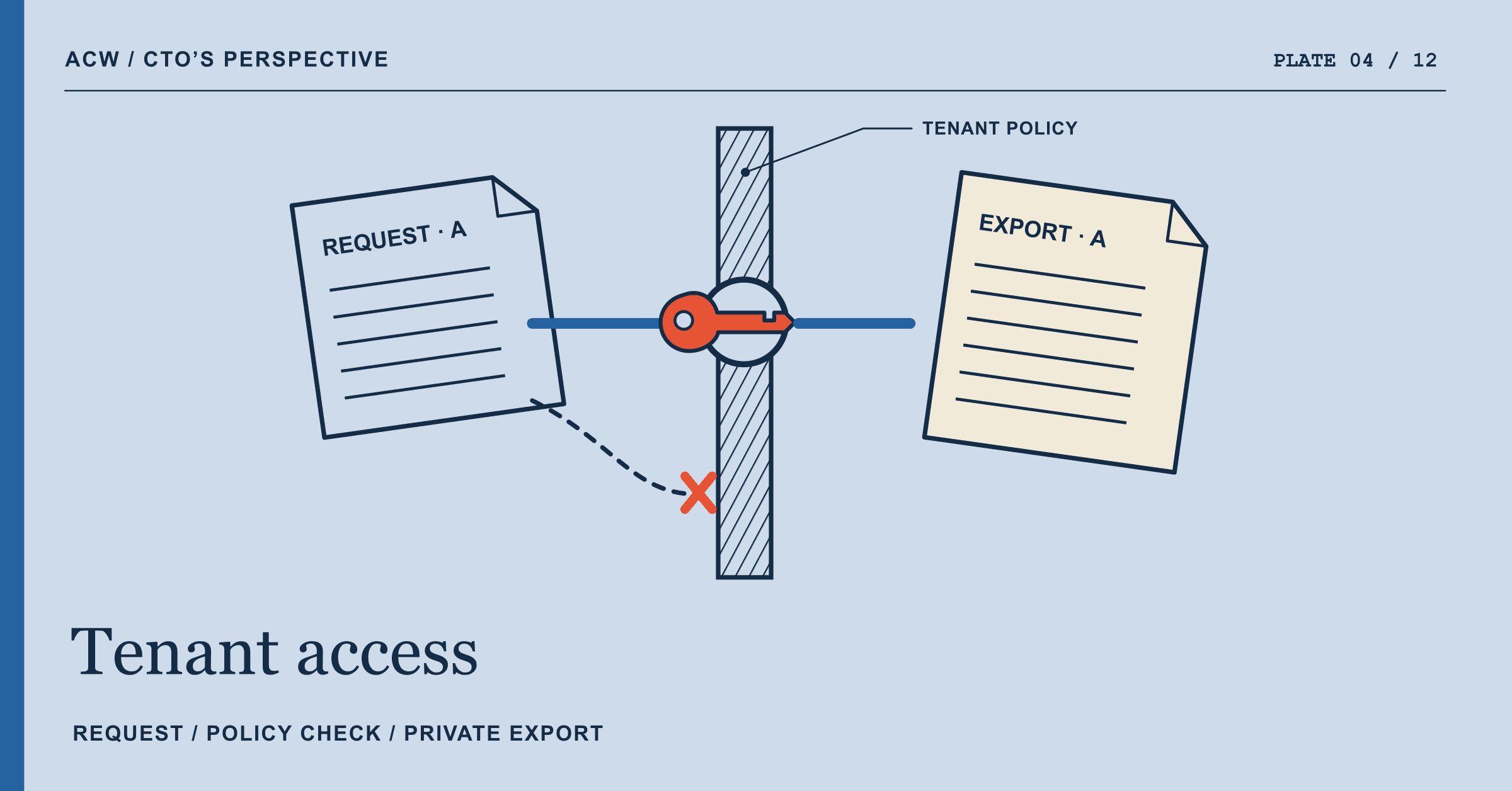
Test the complete export with two accounts from different tenants. Verify that the entitled user receives the expected synthetic records and that the other account cannot inspect the job, retrieve the file or obtain restricted metadata. Repeat the checks after a role change. The release decision depends on how the API, worker and download path enforce the same business rule.
What are we evaluating?
Review basis. Documentation review. Conclusions drawn from official documentation and published material, without a test of our own.
Methodology. Compared the OWASP object-authorization guidance with ACW’s published review and recruitment themes. Walked through a hypothetical export using two employers and an agency recruiter. No hands-on or production runs were performed.
Where does the customer's authority end?
Start with the file the customer can actually take away. In a hypothetical recruiting platform, an employer can export a shortlist for a vacancy it manages. A recruiter who can sign in and export the shortlist for Employer A should still be unable to retrieve Employer B's file. The relevant business promise covers the whole lifetime of the document, including the time after a user leaves the hiring team.
Broken object level authorization occurs when a service accepts an identifier for a record without sufficiently checking the caller's right to perform the requested operation on that record. OWASP describes this risk even when identifiers are difficult to guess. The test therefore needs a real identifier belonging to the other test tenant. Guessing names until a request fails tests something else.
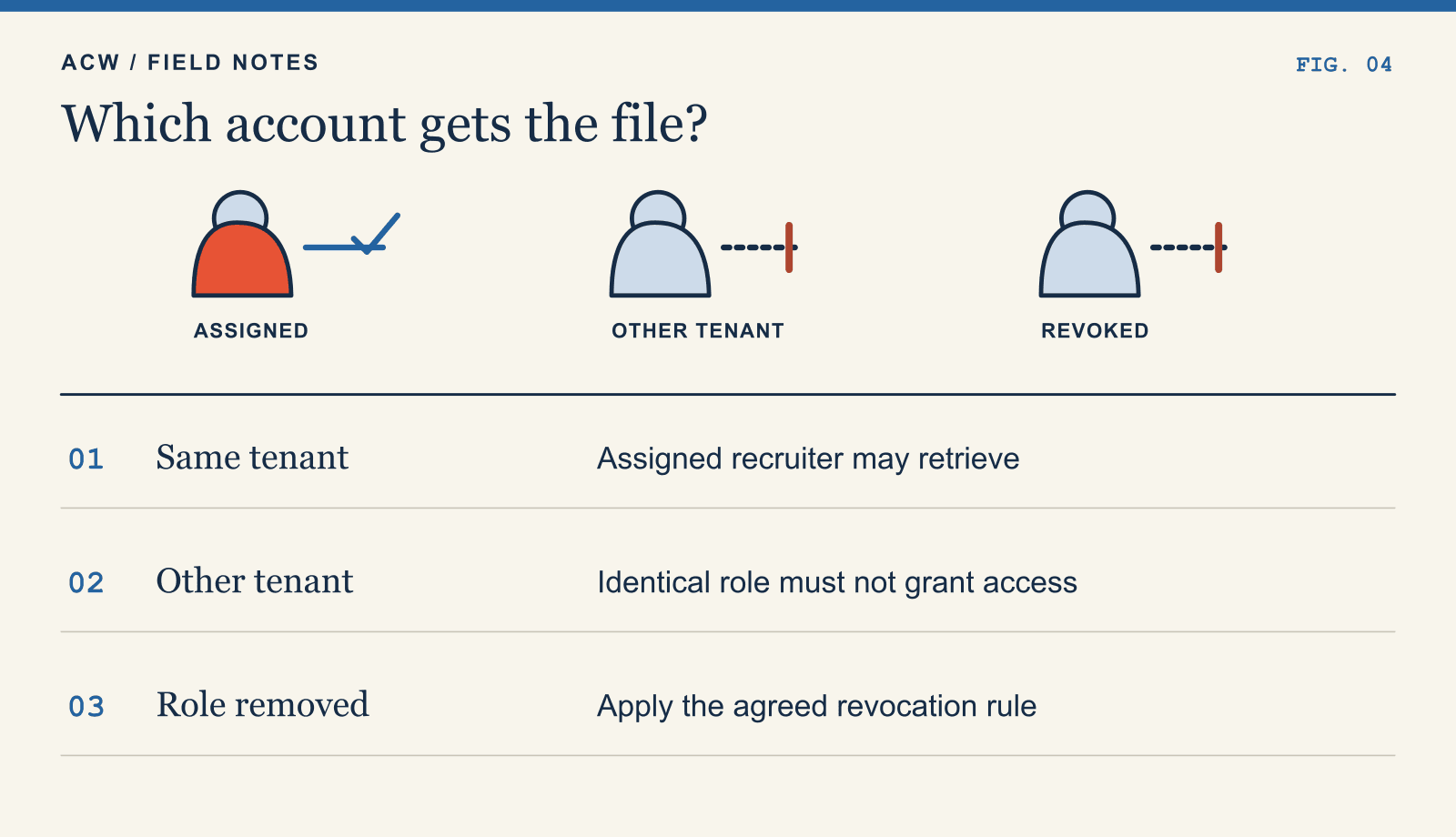
Write the policy as a sentence that product, engineering and support can all apply. For example, a recruiter with an active assignment may download a completed export for that assignment's employer. Ask the product owner what should happen to an already prepared file if the assignment ends. Both revocation and continued access have product consequences. An engineer cannot infer the answer from the route name.
Which pair of accounts makes a useful test?
Create two synthetic employers with similar names, the same plan and disjoint vacancies. Give each a recruiter with the same role. Place a harmless marker in each synthetic shortlist so that a reviewer can identify the returned material by content. Keep the accounts deliberately alike except for tenant membership. A denial caused by a different subscription or a disabled feature obscures a missing ownership check.
Start with a valid export from each account. Record the request that starts the job, the job-status call and the download request. Substitute only the job or document identifier while keeping the original user's credentials. Repeat the exercise in the opposite direction. Capture the response status, whether a download location was disclosed and which bytes, if any, arrived.
A useful negative result keeps the other tenant's existence private to the degree promised by the product. Returning an empty document while disclosing its original filename may still reveal the name of a vacancy. Decide what metadata may be visible before judging the result. Retain synthetic identifiers and expected outcomes with the test so it can run after the next refactor.
What belongs in the server-side decision?
Resolve the user's account from trusted session information and look up the requested resource within that account's permitted scope. Apply the policy to the action being attempted. Permission to see a vacancy summary need not include permission to export applicants' contact details. Separate permissions make it possible to explain why the same account can open a page but cannot download its underlying data.
An application assembled with a coding assistant can make a convincing page by hiding a button when the user lacks a role. A direct request does not pass through that button. ACW's published position on AI-written code calls for inspection before release. For an export feature, inspection means identifying the server function that reaches the privileged data and showing which rule runs first.
Choose how to behave if the resource has no owner, a migration leaves an association missing or a shared service fails to resolve membership. Treat each case as an explicit product state. A convenience fallback that returns an unscoped record makes a temporary data problem into an access problem. A refusal with a support reference gives operators a way to investigate.
What changes when the export moves into a queue?
Carry an explicit tenant and job identity through the queue. An HTTP request can be authorized correctly while a worker later fetches records using a broader service account. Inspect the worker query, the destination used to store the file and the endpoint that issues the download. A worker that reads the correct rows but overwrites another tenant's file can produce the same customer-visible failure as a faulty query.
Queue a synthetic export, pause the worker, change the recruiter's assignment and resume processing. The team should predict what happens before it presses resume. Should the job complete for an authorized employer administrator, disappear, or stay available only to the requester if still employed? Document who may collect the result. The answer determines which checks belong at submission, processing and collection.
Inspect cache behavior with two accounts in succession. The same route can produce different content depending on the session. Test a fresh browser session as well as an already-open tab. If the system issues a temporary download link, characterize who can use that link until expiry and decide whether its lifetime meets the product's revocation promise.
What evidence should block a release?
Block when a forbidden action returns a file, exposes prohibited metadata or leaves a retrievable artifact in a shared location. Keep a passing result next to each denial. A blanket rejection can make every negative test pass while breaking every paying customer's export. A narrow acceptance record proves the useful feature and its boundary together.
Record the exact route, actor, tenant relationship, action, expected outcome and observed outcome. Ask a second engineer to reproduce the failing request with synthetic data before accepting a fix. That engineer should be able to tell whether the change corrected the underlying query or merely suppressed one route. Check adjacent operations such as preview, export history and bulk download.
Use the resulting matrix when deciding where to spend the next engineering day. If preview and download share one authorization function, one policy test may cover much of the logic, with a small integration test at each entry point. If the worker and API use independent lookups, each needs its own evidence. Similar endpoint names tell you little about the implementation.
How should support handle a disputed download?
Give support a way to locate the export without opening its contents. A customer can report a time, workspace and export reference. An engineer with appropriate access can then trace which identity requested the work, which tenant the worker resolved and when the file was made available. Agree who can access that trace and how long it should be retained.
Create a route for reporting a suspected cross-account download. Keep the candidate fix separate from the decision about any existing links or artifacts. Correcting tomorrow's authorization check does not answer who could still retrieve yesterday's file. An incident owner needs to examine those paths and decide what to invalidate, with reference to the actual storage design.
Approve rollout only when all customer-visible routes are covered, ownership changes have a defined outcome and a named person can trace a report to its job. Revisit the matrix when adding delegated recruiters, agency accounts or shared vacancies. Each introduces a legitimate cross-organization relationship that a simple rule equating user tenant and file tenant may no longer express.
What would a reviewer put in an export test record?
Use a record that another engineer could execute without knowing who wrote the feature. Give the two employers stable fictional names and give each vacancy a memorable marker. Write the allowed and forbidden requests side by side, leaving every parameter except the resource identifier unchanged. Save the expected result before the first run. Otherwise the test record can quietly inherit whatever behavior the implementation happens to produce.
For an agency recruiter assigned to two employers, repeat the check with a third employer outside the agency agreement. The original two-account test no longer distinguishes legitimate cross-account work from an overly broad agency role. Add a recruiter with an expired assignment as a separate actor. That fixture lets the team inspect what happens to bookmarked downloads after a contract ends, an outcome a simple role comparison would miss.
Follow one artifact through deletion as well. When an employer deletes a shortlist, does the product promise to remove a stored export, revoke access to it or simply remove it from the list? Find that answer in the actual service policy. Design the test against that promise and state whether copies already downloaded by an authorized user fall outside the system's control.
To close the review, let a colleague run a synthetic export from a new session after changing the user's role. Ask them to state which check made the final decision. If their evidence is only that a button disappeared, the review still has a gap. If they can show the resource, actor, operation and observed result, the product owner has a concrete basis for accepting the boundary.
Give the support lead two example complaints, one concerning a missing export and one concerning an unexpected filename. Both may arrive as a generic download problem. The lead should know which reference to collect and which path requires immediate escalation to security, without asking either customer to email a copy of someone else’s records.
What are the limitations and trade-offs?
- The examples cover object access to exports.
- Storage policy, cache rules and link expiry must be verified in the actual system.
Sources and methodology
- API1:2023 Broken Object Level Authorization (opens in a new tab). OWASP · Accessed 4 Nov 2026
- Reviewing AI-generated code (opens in a new tab). ACW Soft Solutions · Accessed 4 Nov 2026
- Job platform for candidates and recruiters (opens in a new tab). ACW Soft Solutions · Accessed 4 Nov 2026
About the author. Oleksandr Veklych, Co-founder & CTO, ACW Soft Solutions. Oleksandr Veklych is the CTO and co-founder of ACW Soft Solutions, where he leads technical strategy and delivery for custom software: SaaS platforms, marketplaces, internal business systems, mobile apps and AI-based solutions. His focus is turning growing complexity into clear architecture, reliable delivery and scalable technical decisions, so teams can move faster without rebuilding everything. He holds a bachelor’s degree in cybersecurity from Taras Shevchenko National University of Kyiv. View profile