

Transfer a support conversation when the next decision requires authority, evidence or judgment the chatbot lacks. Send the adviser the verified facts, the customer’s own request and the unresolved decision. Judge the design by the customer’s eventual outcome and the time spent reconstructing the case, including repeat contacts that arrive through another channel.
What are we evaluating?
Review basis. Documentation review. Conclusions drawn from official documentation and published material, without a test of our own.
Methodology. Read Ingka’s original account of Billie and remote selling, and Anthropic’s workflow guidance. Examined a hypothetical retail support transfer independently of IKEA’s implementation. No hands-on or production runs were performed.
Where should the handoff happen?
Transfer the conversation as soon as resolving it requires a judgment or permission outside the bot's mandate. A support assistant can explain how to find a receipt. It needs a different level of authority to refund an order placed under another account. Design the handoff around what the next person can do for the customer. Making a customer repeat a claim after three automated exchanges spends the time the bot was meant to save.
A LinkedIn post about IKEA's customer service prompted this question. Ingka's own account describes the Billie chatbot alongside efforts to equip staff for remote selling and design support. That makes the division of work worth examining. It does not supply a staffing forecast for another retailer. A smaller team should first map the inquiries it can actually resolve.
Take a hypothetical furniture retailer. A buyer asks whether a replacement hinge will fit a wardrobe and mentions that a door has already fallen. The first half looks like a catalogue question. The second changes the appropriate response. Design the assistant to notice the change and transfer the whole exchange to someone with the authority and information to handle it.
Which service outcomes should a pilot count?
Count resolved customer needs over an agreed period. A conversation that ends because the buyer gives up may look identical to a successful self-service session in a chat log. Link the pilot to downstream evidence where that is appropriate. A delivered replacement, a confirmed appointment or a customer who says the issue is resolved provides more information than an idle session.
Choose related measures in advance. Track repeat contacts about the same issue, time until a human with the right permission joins and time the customer spends re-explaining the problem. Segment by issue type. A tool can handle store-hour questions well enough to improve the overall average while return disputes take longer to settle.
Create a small, privacy-conscious review sample that includes successful self-service, escalated contacts and silent endings. Have service staff label what can be established from each record. Where the outcome is unknown, retain that category. Treating unknowns as resolved persuades the team to optimize for a short chat instead of a satisfied customer.
What must travel with the customer?
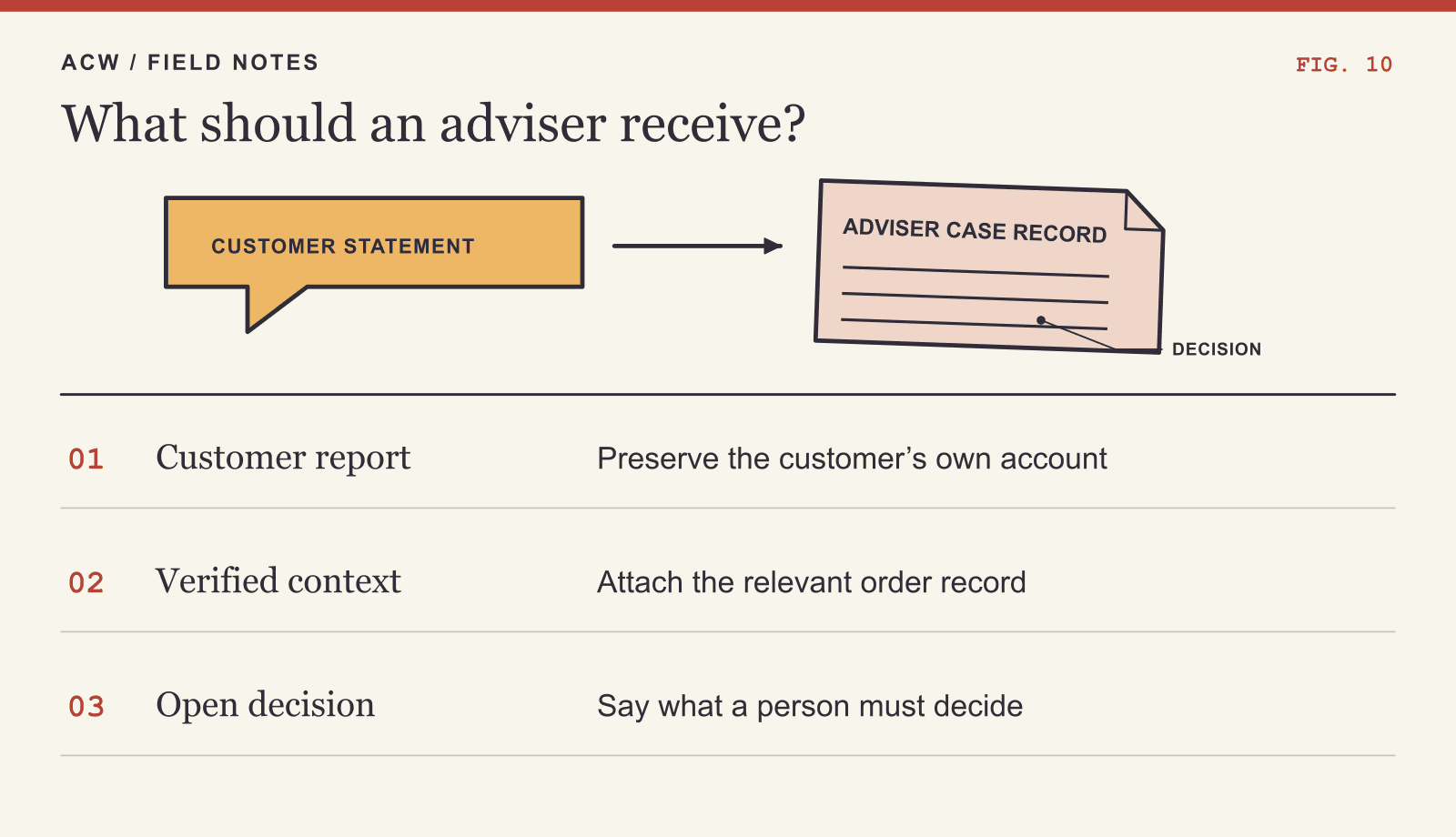
Transfer a compact case record that the receiving colleague can verify. Include the customer's request in their own words, the verified order reference where appropriate, the steps already attempted and the decision that requires a person. Distinguish customer statements from information confirmed in an order system. A tidy summary that silently turns an allegation into a verified fact can bias the next decision.
Consider a buyer who says a parcel never arrived. The shipping system says delivered. Preserve both statements. The assistant may ask whether the delivery address is correct using the organization's normal identity checks. It should not resolve the disagreement by guessing who is mistaken. The recipient needs enough context to open a carrier investigation or explain the available options.
Keep the handoff brief enough to use during a live conversation. If staff routinely reopen the original transcript for basic details, observe the first minute after transfer and identify what they search for. Add the missing field or remove a misleading one. Do not copy a customer's full history into every case when only the current order is relevant.
How should the assistant handle a request that changes?
Re-evaluate the route when the customer introduces new information. A shipment-status inquiry can become a cancellation request while the parcel is already leaving the warehouse. A return can become a complaint about damaged equipment. A classifier chosen on the first message cannot safely govern the rest of the exchange without revisiting the case.
Write tests as short dialogues. Begin with a familiar, routine question, let the bot answer and then introduce a detail that crosses the boundary. Record the turn on which a transfer should occur and which information must reach the receiving team. Include cases where a specialist is temporarily unavailable. The customer needs a truthful expectation about the next contact.
When the customer explicitly asks for a person, define what the service can offer in that channel and at that time. A queue estimate should come from a system that knows the current workload. If the only reliable option is a callback, capture consent and create an identifiable callback task. Reassurance without a recorded follow-up leaves ownership ambiguous.
When does self-service create more work?
Look at the total handling cost of a resolved case, including repeat contacts and downstream investigation. A bot that answers a simple question immediately can be worthwhile even with limited scope. A bot that handles ten turns and transfers a frustrated customer with an inaccurate summary may cost more than a direct transfer.
For an illustrative capacity calculation, suppose 100 requests reach the assistant and 20 reach an adviser. If each transferred case requires five minutes to reconstruct, the handoff itself consumes 100 adviser minutes. Saving two minutes of reconstruction on each transfer would release 40 minutes in this hypothetical sample. The example describes the arithmetic a team can apply to its own cases. It does not predict a reduction in headcount.
Ask what the recovered time can purchase. It might shorten a backlog, allow a specialist to complete a design consultation, or provide capacity for customers who need language assistance. The answer depends on the queue and the staff skills. A spreadsheet entry for saved minutes becomes a service improvement only when somebody can use those minutes.
What earns a wider rollout?
Expand one issue type at a time after the team verifies identity handling, transfer quality and recovery when integration fails. Select a group with comparable order types and hours of operation. Compare the outcomes to a baseline that includes the same customer needs. An unusually quiet week or a delivery outage can distort an otherwise careful pilot.
Give staff a simple way to flag a misleading answer or a handoff that reached the wrong queue. Review examples with the team that owns the relevant policy. If the answer is genuinely ambiguous, a new model instruction cannot settle the policy. Assign a human owner and record which answer applies while the issue is open.
Release the next category only when someone can explain what happens on a routine request, a disputed request and a failed transfer. Keep a direct support route available during the trial. Revisit the decision when returns rules change, a new sales channel opens or the service begins handling customers whose orders it cannot verify.
What should the first handoff record look like?
Give the receiving adviser a record with four short fields. The customer's request might read that a replacement door is needed for an existing wardrobe. The verified facts might identify the order and the item originally purchased. The customer's account of what happened should remain separately attributed. The requested decision might be whether replacement parts, a return or a specialist review is appropriate under the store's actual policy.
Read the record aloud as if the customer had just joined a phone call. An adviser should be able to say what they already know and ask only for information that genuinely changes the next step. If the summary says the product failed but the user only reported visible damage, the bot has already overspecified the cause. Revise the handoff field so observations and conclusions remain separate.
Now interrupt the transfer. Suppose the contact centre closes between the start of the conversation and the request for an adviser. The system needs an approved after-hours action, a durable reference and wording that describes the pending contact accurately. A ticket stored only in the chatbot conversation may never reach the morning queue. Follow the test through the start of the next shift and check who owns the outstanding promise.
Repeat with a customer who contacts the store again from another channel. Decide which identity checks allow an adviser to locate the earlier case. A good handoff avoids repetition without disclosing another person's order. If no verified link exists between the two contacts, the adviser should see a clear reason to verify identity again.
Compare the original chat, the transferred record and the final service action. Differences among them reveal exactly where the customer had to repair the process. Use those observations to prioritize integration work before trying to broaden the bot's language coverage.
Document the fallback for a customer who cannot use the chat interface or does not consent to an automated exchange. Exercising that route during the pilot reveals whether the service improvement reaches the whole audience. An impressive resolution rate among customers who stayed in the bot says little about the experience of those who had to find a different entrance.
What are the limitations and trade-offs?
- The retailer’s policy, identity checks and staffing determine which handoffs can be offered.
- Ingka’s results are not a forecast for another business.
Sources and methodology
- AI and Remote Selling bring IKEA design expertise to the many (opens in a new tab). Ingka Group · Accessed 4 Nov 2026
- Building effective agents (opens in a new tab). Anthropic · Accessed 4 Nov 2026
About the author. Oleksandr Veklych, Co-founder & CTO, ACW Soft Solutions. Oleksandr Veklych is the CTO and co-founder of ACW Soft Solutions, where he leads technical strategy and delivery for custom software: SaaS platforms, marketplaces, internal business systems, mobile apps and AI-based solutions. His focus is turning growing complexity into clear architecture, reliable delivery and scalable technical decisions, so teams can move faster without rebuilding everything. He holds a bachelor’s degree in cybersecurity from Taras Shevchenko National University of Kyiv. View profile