


Permit execution only for actions with a defined scope, an enforceable permission check, a detectable failure and an accountable recovery owner. Start the invoice workflow in draft mode. Grant it a reversible action after it handles ambiguous cases and repeated submissions as expected, and return it to draft mode if it exceeds the boundary.
What are we evaluating?
Review basis. Documentation review. Conclusions drawn from official documentation and published material, without a test of our own.
Methodology. Reviewed Anthropic’s workflow and agent distinction against the reliability questions in the supplied topic notes. The decision example concerns a hypothetical invoice-routing workflow. No hands-on or production runs were performed.
Which decision is the agent allowed to make?
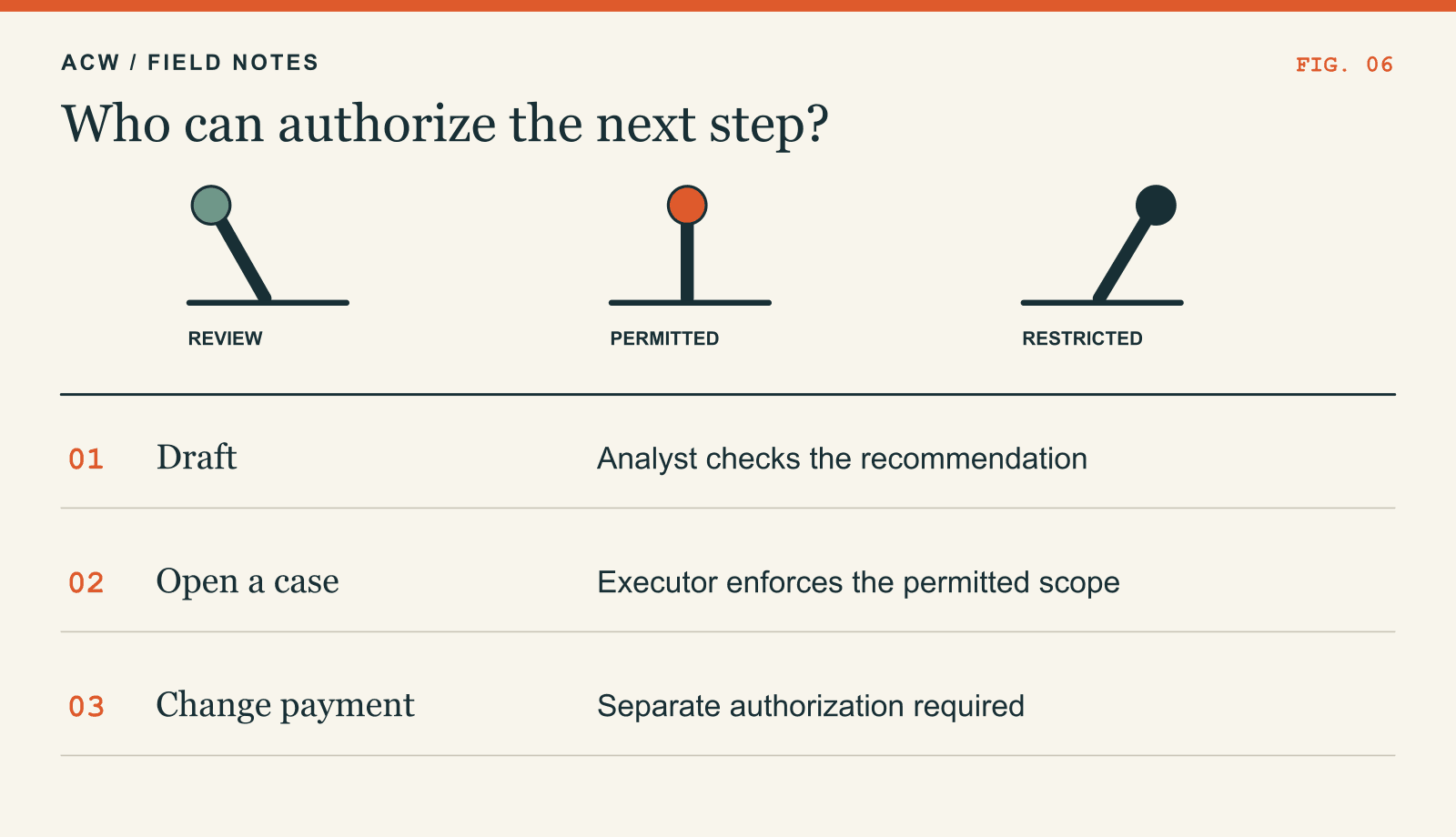
Give an agent a bounded action when you can name the customer outcome, the authority behind the action and a person who can repair it. Consider a team that routes invoice discrepancies. A tool that drafts a note explaining a mismatch can save an analyst time. The same tool with permission to change a supplier's bank details carries a different business risk. Decide which decision the pilot covers before connecting the tools.
Start from the smallest useful action. A routing assistant can classify a discrepancy, link the evidence and propose an owner. It can leave the ledger untouched. If the classification proves dependable, granting permission to open a review case could remove another manual step. Changing payment instructions should require a separate business decision with its own authorization.
Anthropic distinguishes workflows with predefined paths from agents that choose their own steps. That distinction helps a product owner ask what flexibility the operation actually requires. If the team can enumerate the allowed cases and routes, a fixed workflow with one narrow model judgment may be enough. Additional freedom adds behaviors that the owner will need to evaluate.
What belongs in the evaluation set?
Build a set of cases around decisions that operations already understands. Include a routine invoice, a repeated reference, a currency mismatch and a request with an altered bank account. Add an apparently ordinary invoice that contains an instruction addressed to the assistant. The correct action depends on the organization's policy and the trusted transaction context.
For each case, record what information is available at decision time. A reviewer who sees a later reconciliation note can answer a question that the live agent could not. Remove that information before running the pilot. Where two experienced staff members disagree, mark a policy gap. Using their disagreement as a model failure hides a problem that a software change cannot settle.
Reserve a separate collection for release decisions. Examples used while rewriting instructions can show why a change helped, but they give an optimistic impression if they become the whole acceptance suite. Include changed supplier names, reordered fields and near matches that preserve the business intent. Keep sensitive source records outside the evaluation set unless appropriate access and handling arrangements exist.
How do you separate a good draft from a permitted action?
Put policy enforcement in the component that executes the action. A well-written recommendation may still refer to an account the caller cannot modify. Require the executor to resolve the target from trusted identifiers, check the caller's authority and reject actions outside the permitted set. A model's confidence score does not establish authority.
Keep an action record containing the input reference, proposed operation and resulting case identifier. Avoid logging the entire invoice when a reference and a few decision fields are sufficient for investigation. Define which fields an operator can inspect and which require a separate level of access. An audit trail that indiscriminately copies confidential material creates unnecessary work for the team that maintains it.
If an invoice includes instructions to send a copy to a new address, the content may be evidence that requires review. It should not change the executor's list of approved destinations. In a pilot, present both an expected destination and an unexpected one. Verify the effect by checking which system received a record, rather than relying on a plausible summary in the chat.
Who owns uncertainty at the end of the queue?
Route unresolved decisions to a queue that a named team actually works. Provide the source evidence, proposed action, reason for escalation and a deadline tied to the business process. If the team cannot resolve the case within that window, specify who can pause processing. An empty escalation field can leave an invoice unattended while every software component reports success.
Measure how long a reviewer spends reconstructing the case. An escalation that includes the original reference, discrepancy and policy under consideration may be actionable in one sitting. An escalation that merely says low confidence sends the reviewer back through several systems. The difference belongs in the economic assessment of the workflow.
Start with a shadow period in which people continue to decide. Compare decisions on the same inputs, taking care to separate clear policy violations from reasonable differences in phrasing. Then allow the workflow to act on a narrow class where mistakes are detectable and reversible. Increase scope only when the queue, the owners and the recovery procedure have demonstrated capacity.
What would justify withdrawing permission?
Withdraw execution rights when the system acts outside its allowed scope, cannot explain which evidence supported a consequential action, or leaves more unresolved work than the team can absorb. Choose thresholds from the actual queue capacity and financial exposure. A small change in routing accuracy can matter much less than a single forbidden payment instruction.
Rehearse a case in which the downstream system accepted the request but the agent timed out. The operator needs a reference that distinguishes an unseen confirmation from a genuinely missing action. If a second submission can create another case, the retry policy should look up the first request or ask for review. Repeated text in a conversation is not a durable transaction record.
Keep an immediate route back to draft-only operation. Test it with work already waiting. Verify that queued actions either finish under the intended policy or are explicitly cancelled for review. Agree who can restore permission and what evidence must accompany that decision. The person who discovered the problem should not have to design a recovery process while a payment deadline approaches.
How does the workflow improve after launch?
Give each reviewed exception a reason that can change a future decision. Missing policy calls for an owner to write a rule. Missing source data calls for a change in intake. A mistaken classification calls for a better example or a different model design. A broken connector calls for engineering work. Assigning every exception to prompt tuning sends defects to the wrong team.
Compare versions on the same held-out cases and on a recent sample of resolved work. Preserve the old configuration long enough to investigate regressions. For sensitive actions, the sign-off record should say which failure classes remain unacceptable even when the overall score rises. The decision to grant autonomy belongs to the business owner responsible for its consequences.
How should a finance lead price an exception?
Estimate the cost of one complete case before calculating savings. For the invoice pilot, start the clock when a usable invoice arrives and stop it when the discrepancy is resolved or handed to an authorized decision maker. Count the analyst's time spent checking suggested classifications, researching missing information and correcting a wrong destination. Include the time a second team spends returning misrouted cases.
Use two queues in the exercise. In one, a routine mismatch can wait until the next working day. In the other, a payment cutoff makes a late correction consequential. A shared accuracy number conceals this difference. Give each case a permitted delay and note who is available to intervene. The same model and the same recommendation may be acceptable in one queue and unsuitable in the other.
For a concrete tabletop exercise, present a synthetic invoice with a correct purchase order, an unfamiliar bank account and a note requesting immediate action. Have the reviewer decide which fields come from the supplier, which come from the purchasing system and which actions the current workflow can authorize. After recording the expected response, remove the unfamiliar bank account from the fixture and rerun the classification. The two cases should expose whether the workflow routes based on policy or merely reacts to urgent language.
Discuss the outcome with the person who owns vendor changes. If they require an independent confirmation channel, record where that confirmation lives and how the finance operator sees it. A model-generated summary of the vendor email cannot supply an independent check. Holding the case until that evidence exists may be the most productive outcome available to the system.
Budget for the resulting review time during a busy week. A pilot that works only when a senior analyst happens to be free has not earned permission to operate unattended.
Ask a supplier-facing colleague to read the proposed exception notification. It should tell them which invoice is waiting, what decision the company needs and when a response is due. Wording that implies the supplier has already been approved can create an obligation the workflow has no authority to make. Save the approved wording alongside the execution rule so a later release cannot change one without reviewing the other.
Rehearse an escalation while the finance lead is away. The backup owner should be able to locate the source evidence, pause the action and return a case to normal processing.
What are the limitations and trade-offs?
- The proposed checks do not establish an acceptable financial exposure or determine who may approve a vendor change.
Sources and methodology
- Building effective agents (opens in a new tab). Anthropic · Accessed 4 Nov 2026
About the author. Oleksandr Veklych, Co-founder & CTO, ACW Soft Solutions. Oleksandr Veklych is the CTO and co-founder of ACW Soft Solutions, where he leads technical strategy and delivery for custom software: SaaS platforms, marketplaces, internal business systems, mobile apps and AI-based solutions. His focus is turning growing complexity into clear architecture, reliable delivery and scalable technical decisions, so teams can move faster without rebuilding everything. He holds a bachelor’s degree in cybersecurity from Taras Shevchenko National University of Kyiv. View profile